CopyTickVolume
CopyTickVolume
该函数将所选符号-周期对的历史Tick成交量数据按指定数量存入volume_array中。需要注意的是,元素的排序是从现在到过去,即起始位置为0表示当前条形。
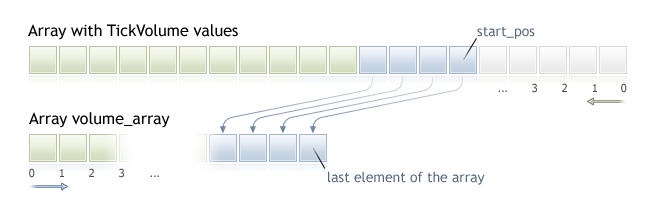
当复制未知数量的数据时,建议使用动态数组作为目标数组,因为如果请求的数据量少于(或多于)目标数组的长度,函数会尝试重新分配内存,使请求的数据完全适应。
如果您知道需要复制的数据量,最好将其存储到静态分配的缓冲区中,以防止过度分配内存。
无论目标数组的属性是什么——as_series=true还是as_series=false。数据将被复制,使得最旧的元素位于数组分配的物理内存的起始位置。函数调用有3种方式。
通过第一个位置和所需元素数量调用
int  CopyTickVolume(
   string           symbol_name,      // symbol name
   ENUM_TIMEFRAMES  timeframe,        // period
   int              start_pos,        // start position
   int              count,            // data count to copy
   long             volume_array[]    // target array for tick volumes
   );
通过起始日期和所需元素数量调用
int  CopyTickVolume(
   string           symbol_name,      // symbol name
   ENUM_TIMEFRAMES  timeframe,        // period
   datetime         start_time,       // start date and time
   int              count,            // data count to copy
   long             volume_array[]    // target array for tick volumes
   );
通过所需时间区间的起始和结束日期调用
int  CopyTickVolume(
   string           symbol_name,      // symbol name
   ENUM_TIMEFRAMES  timeframe,        // period
   datetime         start_time,       // start date and time
   datetime         stop_time,        // stop date and time
   long             volume_array[]    // target array for tick volumes
   );
参数
- symbol_name
[in] 符号名称。
- timeframe
[in] 周期。
- start_pos
[in] 第一个要复制的元素的起始位置。
- count
[in] 要复制的数据数量。
- start_time
[in] 第一个要复制的元素的开始时间。
- stop_time
[in] 最后一个要复制的元素的条形时间。
- volume_array[]
[out] 长类型的数组。
返回值
如果发生错误,则返回复制的数据数量或-1。
注意
如果请求的数据整个区间在服务器上的可用数据之外,函数将返回-1。如果请求的数据超出TERMINAL_MAXBARS(图表上最多条形数),函数也将返回-1。
如果请求的时间序列尚未构建或需要从服务器下载,函数将立即返回-1。
当通过起始日期和所需元素数量请求数据时,只返回日期早于或等于指定日期的数据。这意味着,任何条形开盘时间的值(成交量、价差、指标缓冲区上的值、开盘价、最高价、最低价、收盘价或开盘时间Time)始终小于或等于指定日期。
当在指定的日期范围内请求数据时,只返回该区间内的数据。区间以秒为单位计算。这意味着,任何条形开盘时间的值(成交量、价差、指标缓冲区上的值、开盘价、最高价、最低价、收盘价或开盘时间Time)始终在请求的区间内。
因此,如果当前日期是星期六,尝试复制周周期时间框架的数据,指定start_time=Last_Tuesday和stop_time=Last_Friday时,函数将返回0,因为周周期时间框架的开盘时间总是星期日,但一周的条形并不在指定的区间内。
如果您需要返回与当前未完成条形对应的值,可以使用第一种调用方式,指定start_pos=0和count=1。
示例:
#property strict
#property indicator_separate_window
#property indicator_buffers 1
//---- plot TickVolume
#property indicator_label1  "TickVolume"
#property indicator_type1   DRAW_HISTOGRAM
#property indicator_color1  C'143,188,139'
#property indicator_style1  STYLE_SOLID
#property indicator_width1  1
//--- input parameters
input int      bars=3000;
//--- indicator buffers
double         TickVolumeBuffer[];
//+------------------------------------------------------------------+
//| Custom indicator initialization function                         |
//+------------------------------------------------------------------+
void OnInit()
  {
//--- indicator buffers mapping
   SetIndexBuffer(0,TickVolumeBuffer,INDICATOR_DATA);
   IndicatorSetInteger(INDICATOR_DIGITS,0);
//---
  }
//+------------------------------------------------------------------+
//| Custom indicator iteration function                              |
//+------------------------------------------------------------------+
int OnCalculate(const int rates_total,
                const int prev_calculated,
                const datetime &time[],
                const double &open[],
                const double &high[],
                const double &low[],
                const double &close[],
                const long &tick_volume[],
                const long &volume[],
                const int &spread[])
  {
//---
   if(prev_calculated==0)
     {
      long timeseries[];
      ArraySetAsSeries(timeseries,true);
      int copied=CopyTickVolume(Symbol(),0,0,bars,timeseries);
      for(int i=rates_total-copied-1;i>copied-1;i--) TickVolumeBuffer[i]=0.0;
      for(int i=0;i<copied;i++) TickVolumeBuffer[i]=(double)timeseries[i];
      Print("We have received the following number of TickVolume values: "+(string)copied);
     }
   else
     {
      long timeseries[];
      int copied=CopyTickVolume(Symbol(),0,0,1,timeseries);
      TickVolumeBuffer[0]=(double)timeseries[0];
     }
//--- return value of prev_calculated for next call
   return(rates_total);
  }