IndicatorSetDouble
IndicatorSetDouble
The function sets the value of the corresponding indicator property. Indicator property must be of the double type. There are two variants of the function.
Call with specifying the property identifier.
bool  IndicatorSetDouble(
   int     prop_id,           // identifier
   double  prop_value         // value to be set
   );
Call with specifying the property identifier and modifier.
bool  IndicatorSetDouble(
   int     prop_id,           // identifier
   int     prop_modifier,     // modifier
   double  prop_value         // value to be set
   )
Parameters
- prop_id
[in] Identifier of the indicator property. The value can be one of the values of the ENUM_CUSTOMIND_PROPERTY_DOUBLE enumeration.
- prop_modifier
[in] Modifier of the specified property. Only level properties require a modifier. Numbering of levels starts from 0. It means that in order to set property for the second level you need to specify 1 (1 less than when using compiler directive).
- prop_value
[in] Value of property.
Return Value
In case of successful execution, returns true, otherwise - false.
Note
Numbering of properties (modifiers) starts from 1 (one) when using the #property directive, while the function uses numbering from 0 (zero). In case the level number is set incorrectly, indicator display can differ from the intended one.
For example, the first level value for the indicator in a separate subwindow can be set in two ways:
- property indicator_level1 50 - the value of 1 is used for specifying the level number,
- IndicatorSetDouble(INDICATOR_LEVELVALUE, 0, 50) - 0 is used for specifying the first level.
Example: indicator that turns upside down the values of levels on which the horizontal lines are placed.
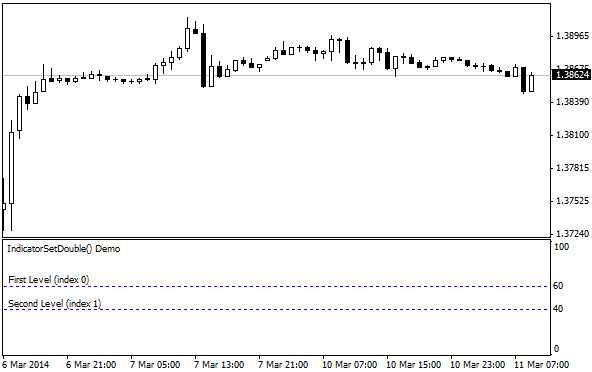
#property indicator_separate_window
//--- set the maximum and minimum values for the indicator window
#property indicator_minimum  0
#property indicator_maximum  100
//--- display two horizontal levels in a separate indicator window
#property indicator_level1 25
#property indicator_level2 75
//--- set thickness of horizontal levels
#property indicator_levelwidth 1
//--- set style of horizontal levels
#property indicator_levelstyle STYLE_DOT
//+------------------------------------------------------------------+
//| Custom indicator initialization function                         |
//+------------------------------------------------------------------+
int OnInit()
  {
//--- two levels
   IndicatorSetInteger(INDICATOR_LEVELS,2);
//--- set descriptions of horizontal levels
   IndicatorSetString(INDICATOR_LEVELTEXT,0,"First Level (index 0)");
   IndicatorSetString(INDICATOR_LEVELTEXT,1,"Second Level (index 1)");
//--- set the short name for indicator
   IndicatorSetString(INDICATOR_SHORTNAME,"IndicatorSetDouble() Demo");
//--- set clrBlue color for all levels
   IndicatorSetInteger(INDICATOR_LEVELCOLOR,0,clrBlue);
//---
   return(INIT_SUCCEEDED);
  }
//+------------------------------------------------------------------+
//| Custom indicator iteration function                              |
//+------------------------------------------------------------------+
int OnCalculate(const int rates_total,
                const int prev_calculated,
                const datetime &time[],
                const double &open[],
                const double &high[],
                const double &low[],
                const double &close[],
                const long &tick_volume[],
                const long &volume[],
                const int &spread[])
  {
   static int tick_counter=0;
   static double level1=25,level2=75;
   static int delta=1;
//--- calculate ticks
   tick_counter+=delta;
//--- check ranges
   if(tick_counter<0) delta=5;
   if(tick_counter>25) delta=-5;
//--- calculate new values
   level1+=delta;
   level2-=delta;
//--- set new values for levels
   IndicatorSetDouble(INDICATOR_LEVELVALUE,0,level1);
   IndicatorSetDouble(INDICATOR_LEVELVALUE,1,level2);
//--- return value of prev_calculated for next call
   return(rates_total);
  }